
The Feast of San Vito Martire is held every year on June 14th and 15thin honor of the patron saint of the town of Avigliano.
The celebrations follow two parallel programs: one religious, the other civil.
The religious program includes Holy Masses (Sante Messe), the Holy Rosary (Santo
Rosario), confessions (penitenza), blessings, and a solemn procession through the streets of the
town in honor of the saint.
San Vito was a Christian martyr who lived between the 3rd and 4th centuries AD. Although he was one of the most venerated saints during the Middle Ages, little is known with certainty about
his life.
According to sanvitoavigliano.it, he was born in 285 AD and died on June 15th, 304.
.A native
of Sicily, Vito is said to have performed many miracles as a child. By the age of seven, his fame had
grown so much that Governor Valerian had him arrested, hoping to force him—through
threats—to renounce his Christian faith.
His father, a staunch pagan, supported the governor in this attempt.
However, young Vito drew strength from the example of his teacher, Modesto, and his nurse, Crescenza, who were imprisoned with him. Their courage and faith were rewarded when an angel sent by God freed them. The three fled to Lucania (an ancient region in southern Italy), where they continued to preach the Gospel and perform miracles.
News of these miracles reached Emperor Diocletian, whose son had epilepsy. Vito was summoned to Rome, where he miraculously cured the boy. But instead of being rewarded, he was tortured to make him renounce his faith. Once again, an angel rescued him and brought him back to Lucania, where, together with Modesto and Crescenza, he gave his final and most powerful testimony of faith—martyrdom.
Legend has it that all three were executed without mercy at the emperor’s command, allegedly influenced by Vito’s pagan father. The martyrdom occurred in ancient Lucania, where the Tanagro River flows into the Sele River.
Today, San Vito is invoked to protect against the illness that bears his name—“St. Vitus’ Dance” (il Ballo di San Vito), an old term for chorea, a neurological disorder causing involuntary movements. He is also called upon to protect against venomous or rabid animal bites.
The local Cultural and Recreational Association notes that the origins of the cult of San Vito in Avigliano are uncertain. However, it is an ancient tradition that dates back well before the 16th century.
The present chapel dedicated to the saint was built in the 1500s on the ruins of a more ancient church. It has been restored several times, including renovations to the façade and the construction of the bell tower (campanile) in the 1950s.
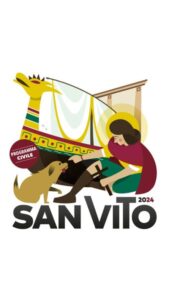
One of the most beloved traditions occurs on on June 15th, when animals are brought to the church for a special blessing. San Vito is considered the patron saint of animals, particularly dogs, and he is often depicted with one or more dogs at his side.. . .
The civil program includes festive activities such as marching bands from nearby towns performing throughout the city streets starting in the morning, orchestral concerts, comedy shows, folk group performances, and the highly anticipated "Corteo Storico di San Vito" (Historical Parade of San Vito), which takes place on June 14th. The festivities conclude on June 15th with a spectacular fireworks show over the town and a live concert. . . . . . . .
More info:
https://www.facebook.com/SanVito22

 English
  Italian