
The Chapel of the Mysteries stands on the foundations of the former medieval Church of Saint Nicholas of the Market, which was demolished in the second half of the 13th century.
In the early years of the adjacent Church of Saint Dominic, these rooms served as the sacristy and storage space for liturgical furnishings. In 1574, the Dominican friars granted the space to a group of lay devotees of the Most Holy Rosary. The group took possession and began building a series of altars, starting with one dedicated to the Miracle of Soriano.
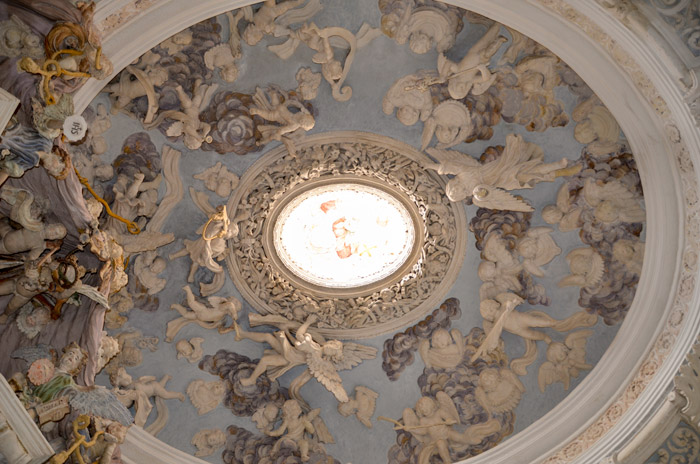
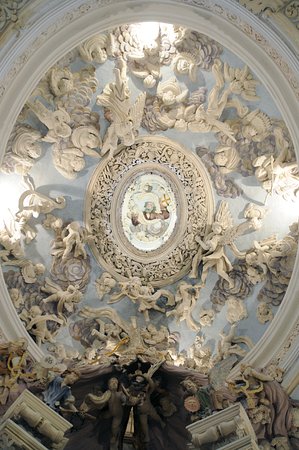
With its lavish decoration, this Baroque altar visually narrates the miracle, transforming it into a material and theatrical experience. The dome above, painted with celestial scenes, features the figure of God the Father, blessing with one hand and holding the globe with the other. Angels and cherubs swirl around in music and dance, creating a jubilant vision of heaven. A richly painted curtain sweeps downward, dramatically unveiling the altar below. In the center, the Virgin Mary—dressed in a pink robe and blue mantle—offers a portrait of Saint Dominic to the saint himself.
The chapel’s decoration is full of symbolic meaning. On the broken pediments, two kneeling angels hold the instruments of Christ’s Passion. Beneath the canopy, two flying cherubs carry the emblems of Saint Dominic: a lily representing chastity, the book of the Gospels, a crown, and a dog with a torch.
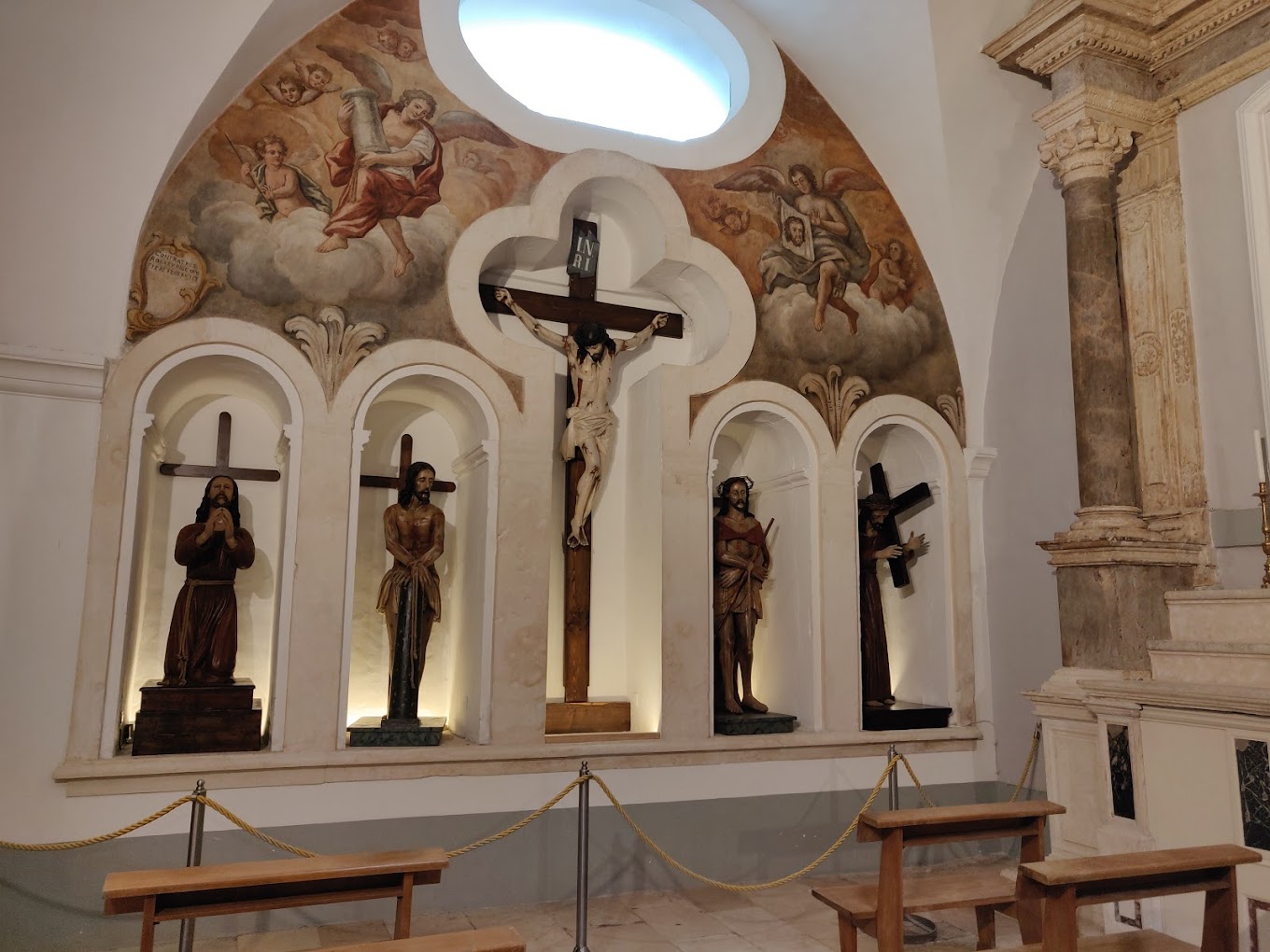
The chapel is home to the sculptural images of the Mysteries of Christ’s Passion, preserved by the Archconfraternity since the early 18th century.
The first recorded Procession of the Mysteries took place in 1714, on the night between Holy Thursday and Good Friday. The 17th-century statues, placed in niches carved in the 1730s, portray Christ in the Garden of Gethsemane, Christ Bound to the Column, the Ecce Homo, and Christ Carrying the Cross.At the center of the chapel stands a papier-mâché crucifix from the region of Lecce, dating to the second half of the 19th century. This replaced the original wooden crucifix, which is now housed in the main church.
Beyond its role as a devotional space, the Chapel of the Mysteries also served as a privileged burial site for Bitonto’s nobility. Commemorative plaques honor Planelli, Giannone, and Bove family members, who financed the church's construction and altars. In 2013, during floor restoration work, ten interconnected burial chambers were discovered. These tombs were intended for friars, lay brothers, and noble patrons. One chamber, located at the chapel's entrance, has been left open in hopes that it can one day be accessible to visitors.

Borgo Racconta is a registered trademark of
BweB – PiccolaGrandeItalia.TV
 English
  Italian
  German