
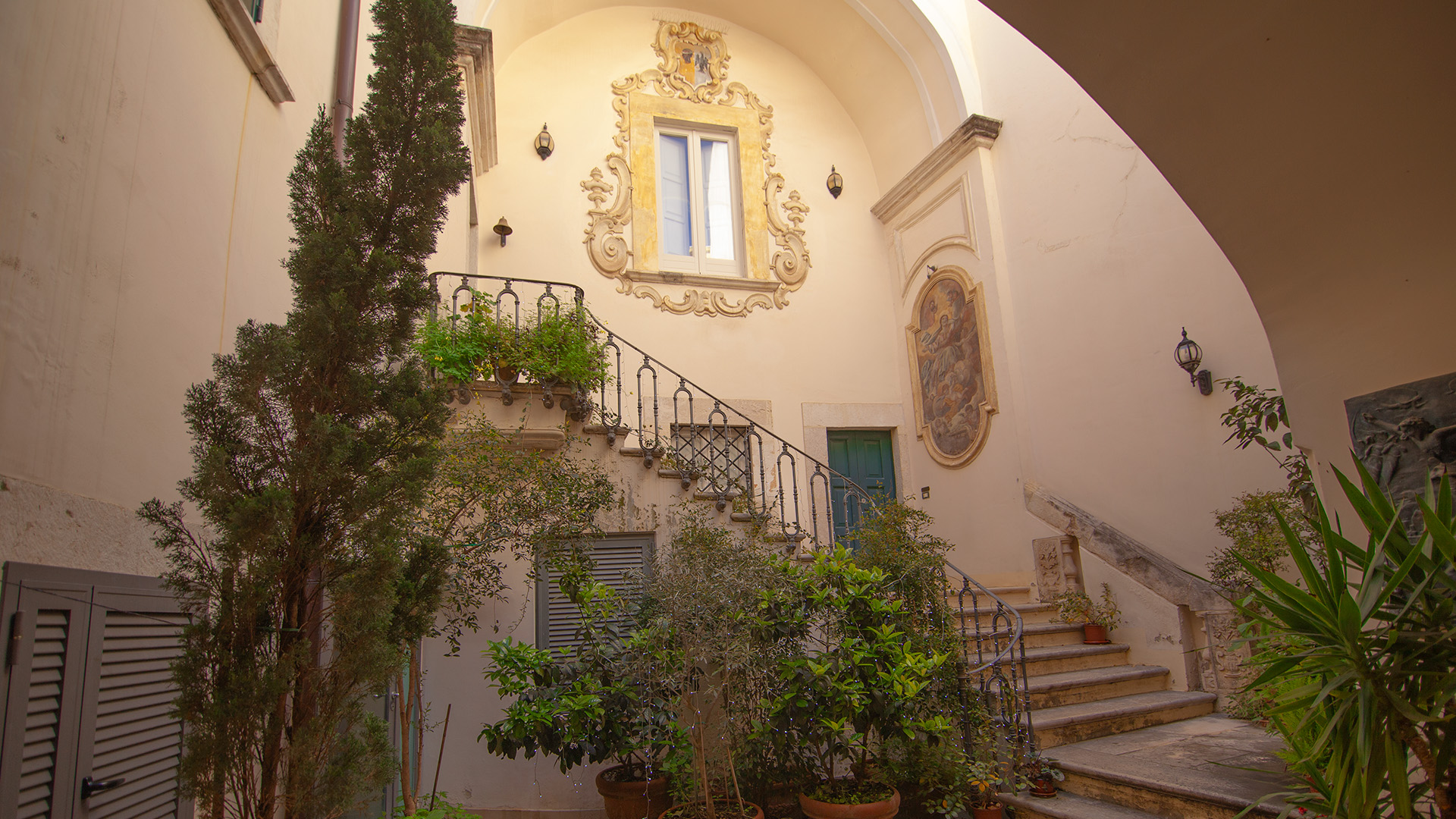
Built in the 16th century by the Santorelli family, this noble residence overlooks two medieval courtyards and incorporates earlier structures within its layout.
The building originally belonged to the Santorelli family, one of Bitonto’s prominent noble lineages until the 16th century. The residence's expansion began in 1450. Later, thanks to a well-planned marriage strategy, the family merged with the Labini, giving rise to a new branch. A stone coat of arms from 1668, still visible on a small terrace, bears witness to this transformation. It features a palm tree, an olive branch, and a star shining its light over three hills.
As part of the renovations, the original Renaissance façade was demolished and replaced by a new one, designed by master builders Domenico and Nicola Valentino, renowned artisans of their time and known to have worked with the famed architect Luigi Vanvitelli.
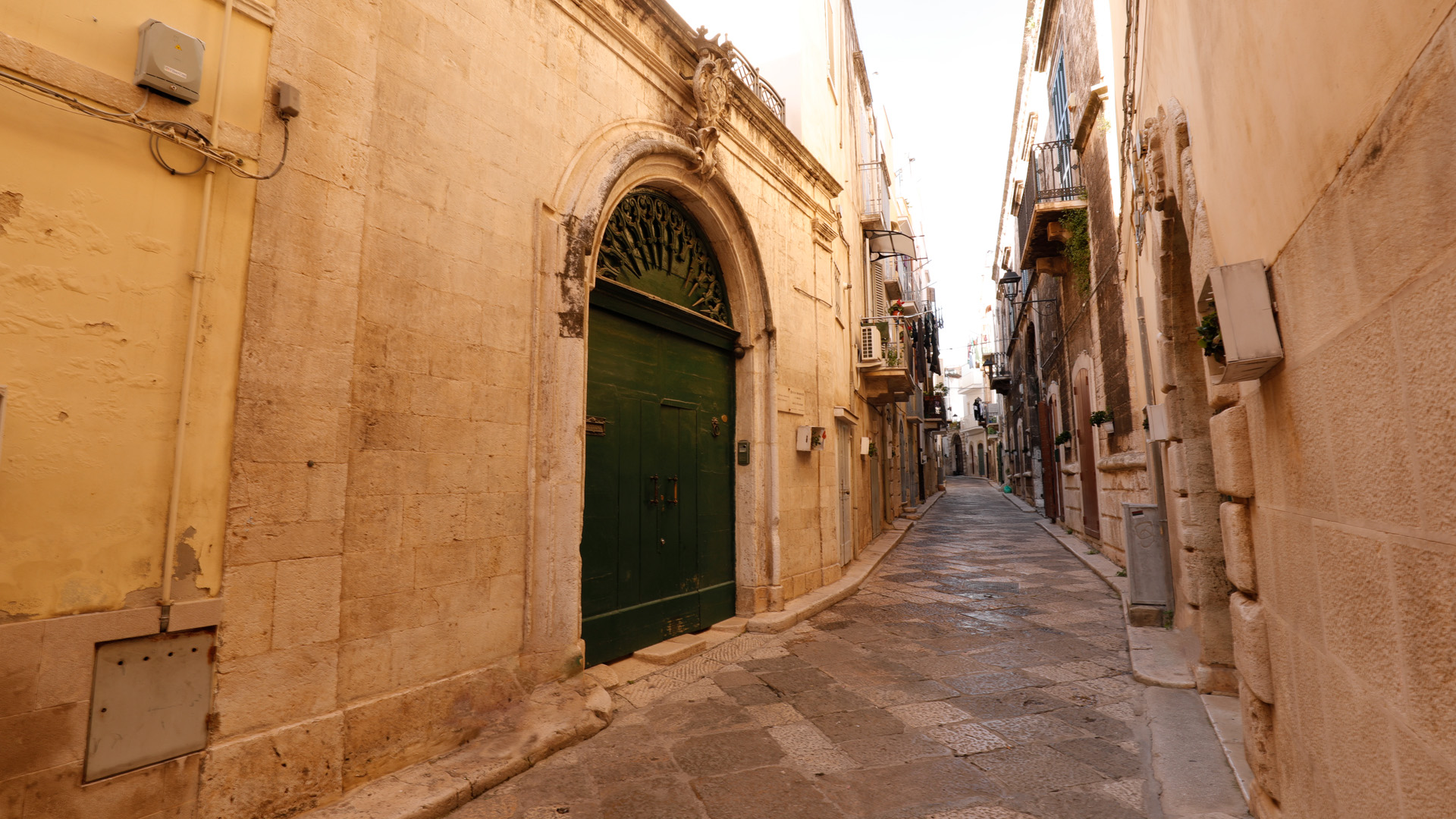
The result was a front inspired by the Borrominian style, built over three levels. It features an arched entrance and a small balcony displaying the Santorelli family’s coat of arms—a rearing lion with a diagonal band and three scallop shells.
Despite the many changes, some elements of the original 16th-century structure were preserved, including painted decorations like a depiction of the Madonna and Child from the same period. In 1750, a private chapel was added inside the palace.
One particularly notable feature is an encaustic painting of the Assumption of the Virgin in the courtyard.
Over time, the building changed ownership several times and underwent further modifications. The Fione family expanded the structure, while later owners—the Ferrante family—did a series of renovations, enlarging the rooms, replacing the flooring, and decorating the walls according to the tastes of the time. These included tempera wall paintings inspired by The Four Seasons, likely created by local artists, possibly from the evening drawing school of Bitonto.
After the Ferrante family's extinction in the 1950s, the building was converted into high-end rental housing. Today, Santorelli Palace is privately owned by the Gesmundo family, which continues to preserve its charm and historical legacy.

Borgo Racconta is a registered trademark of
BweB – PiccolaGrandeItalia.TV
 English
  Italian
  German