36 - Early Christian Substructure of the Cathedral

The Mosaic of the Griffin and the Remains of the Early Christian Structure

Audio Guide Transcript

Beginning in 1991, archaeological excavations beneath the Cathedral of Bitonto uncovered a new chapter in the site’s ancient history. Around four meters below the current floor level, researchers brought to light a colorful mosaic pavement from the Early Christian period, along with structural remains, sculptures, ceramics, coins, and other materials—now all visible along the dedicated visitor path.

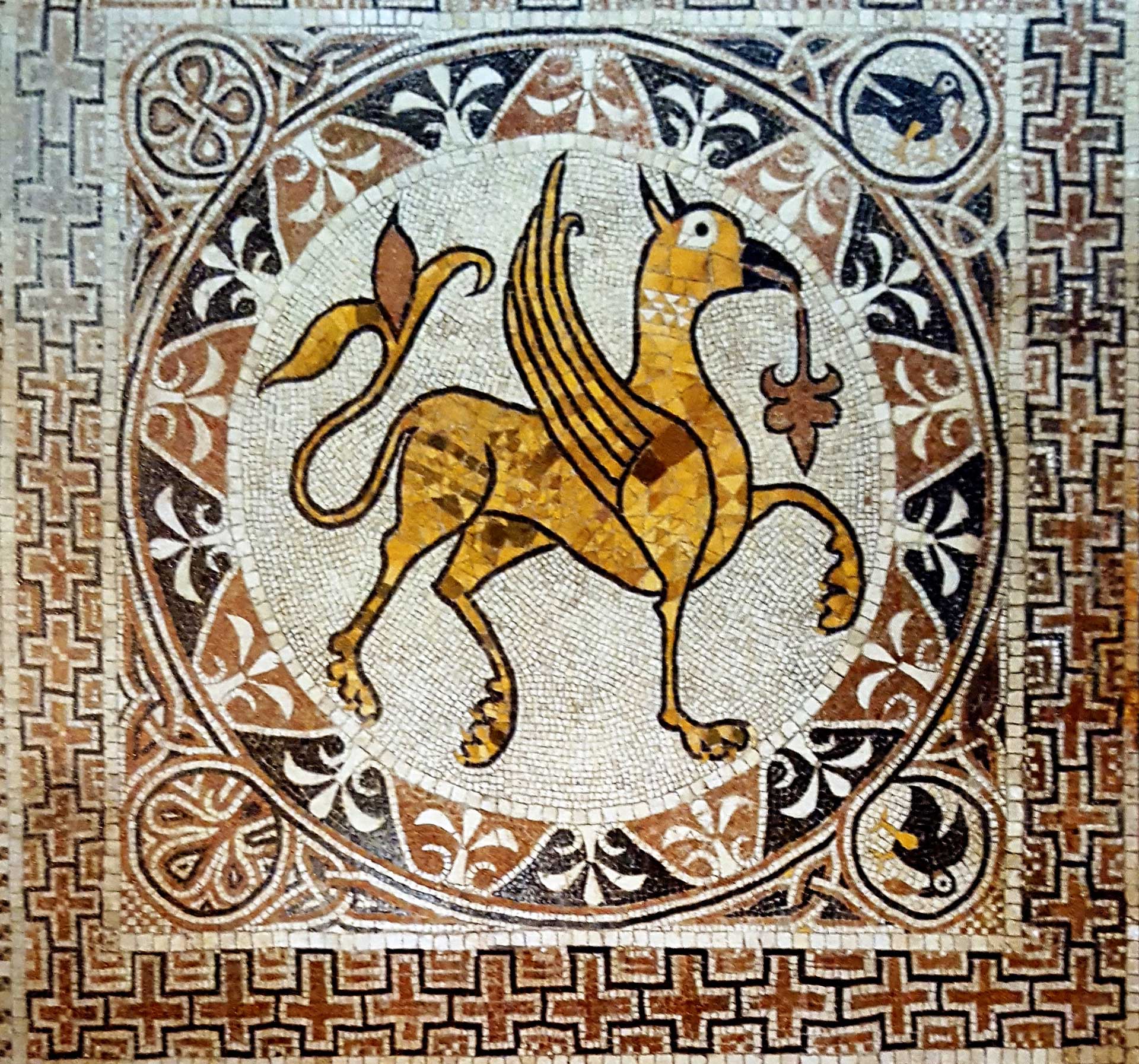
But one discovery draws the eye: a remarkably well-preserved mosaic, dating back to the mid-11th century, depicting a rampant griffin enclosed within a double circular frame. Despite centuries of architectural transformation and the passage of time, this masterpiece has survived intact.

The tesserae that compose it are crafted from white, red, and black-gray limestone, as well as colored marbles—most notably, a deep antique yellow. Executed with extraordinary skill, the mosaic’s surface gleams with vibrant color and striking geometric precision.

With its curved beak holding a flower, the griffin is set within a central ring bordered by alternating red and black backgrounds adorned with white palmettes. Four smaller circles branch out from this central medallion, connected by a slender ribbon. Each contains a symbolic motif: two birds, a plant, and a four-petaled flower. The composition is encircled by an outer border of repeating white, red, and black crosses.

The griffin—a legendary creature combining the lion, king of the earth, with the eagle, ruler of the sky—symbolizes the dual nature of Christ in Christian iconography, both human and divine. As if about to leap skyward, the beast's raised front paw reinforces this ascensional, redemptive image. The design, which closely echoes illustrations from medieval bestiaries, reveals the hand of a highly cultured and technically gifted artist.

Use the map to explore

1 - Gentile’s Palace

2 - Church of Saint Francis of Paola

3 - De Marinis Palace

4 - Ventafridda Palace

5 - Chapel of Saint Matthew

6 - Pannone–Ferrara Palace

7 - Tommaso Traetta Theater

8 - Angevin Tower

9 - De Ferraris–Regna Palace

10 - Church of Saint Gaetano

11 - Sylos–Calò Palace

12 - Girolamo and Rosaria Devanna National Gallery

13 - Church of the Souls in Purgatory

14 - Scaraggi–Labini Palace

15 - Santorelli Palace

16 - Church of Saint Francis of Assisi

17 - Convent and Cloister of Saint Francis of Assisi

18 - Diocesan Museum and Hanging Gardens

19 - Bove Chapel – Saint Mary of Compassion

20 - Bove Palace

21 - Chapel of Saint Anne and the Council Hall of the Nobles

22 - Rogadeo Palace

23 - Planelli–Sylos Palace

24 - Vulpano–Sylos Palace

25 - Bove–Planelli–Tèrmite Palace

26 - Church of Saint Dominic

27 - Chapel of the Mysteries

28 - Gentile – Labini – Sylos Palace

29 - Church of Saint Teresa

30 - Carmine Sylos Classical High School

31 - Old Church of Saint Leucius

32 - Franco–Spinelli–Regna Palace

33 - Giannone–Alitti Palace

34 - Cathedral of the Assumption of Mary

35 - Crypt of the Cathedral

36 - Early Christian Substructure of the Cathedral

37 - Church of Saint Nicholas of the Hospital

38 - De Lerma Palace

39 - Church of Saint Sylvester

40 - Monastery of Saint Mary of the Virgins

41 - Barone – Gentile – Sisto Palace

42 - Albuquerque Palace

43 - Church of Saint Valentine

44 - Church of Saint Catherine of Alexandria

45 - Francesco Spinelli School of Drawing

46 - Cioffrese Palace

47 - Chapel of the De Ìlderis Family and Agèra Gallery

48 - Battle Academy Museum

49 - Church and Cloister of Saint Peter the New

50 - Sylos–Sersale Palace

51 - Church of Saint George

52 - “Spazi della Memoria” Museum

53 - Church of the Annunciation

54 - “De Palo – Ungaro” Archaeological Museum

55 - Nicola Fornelli School Building

56 - Church of Saint Vitus

57 - Convent of Saint Leo the Great

58 - Church of the Crucifix

59 - Church of Mary Most Holy of the Immaculate Conception

60 - Church of Our Lady of Sorrows

en_USEnglish