
The Old Church of Saint Leucius is one of the most ancient sacred buildings in Bitonto, nestled in a quiet and atmospheric corner near the Church of Saint John the Evangelist. Several attempts to suppress it have been made in its long history, all of which were prevented by strong opposition from the clergy and local citizens.
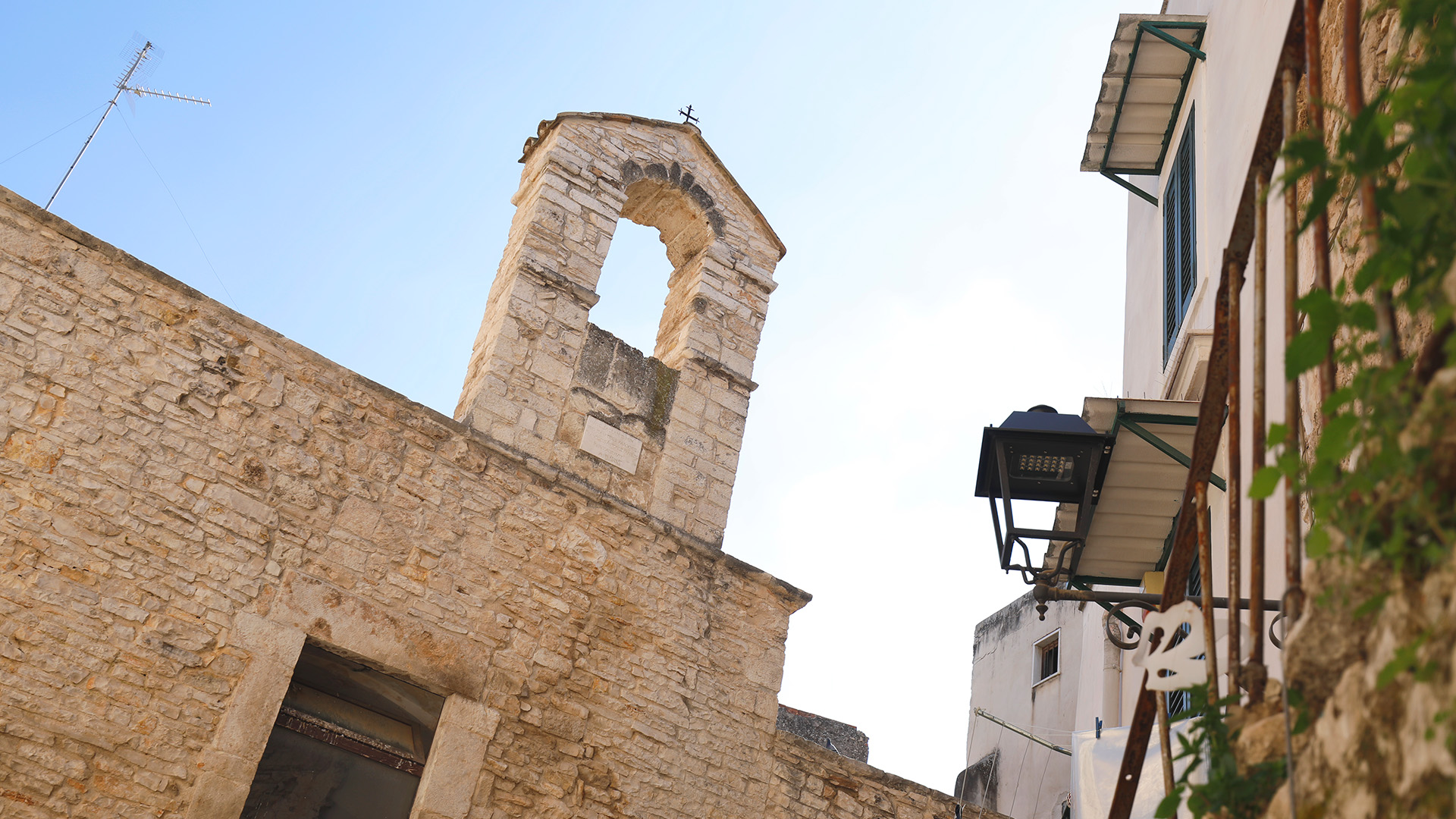
The church dates back to the 10th century. It features a rustic stone façade with a pyramid-shaped structure topped by a small bell gable. There are two entrances: the main door is framed by a round arch and a large window above it, while the smaller side door features a coat of arms on its lintel.
Inside, the space is divided into two naves of equal size, separated by a central pillar that supports two arches. These, in turn, provide the base for the groin vaults added in 1762, likely replacing an earlier ceiling of semi-spherical domes.
The church remained in use as a parish until 1906, after which it fell into neglect. It wasn’t until the second half of the 20th century that restoration efforts—led by the Center for Historical Research and overseen by the Office for the Protection of Cultural Heritage—brought it back to life. These works allowed for the recovery and preservation of precious frescoes, including a Madonna and Child and a Christ Pantocrator. Other frescoes from the site have since been moved to the Diocesan Museum.
Next to the church stands a small garden, once used as a cemetery. From here, visitors can admire the apses—distinct architectural features that confirm the early medieval origin of this remarkable building.


Borgo Racconta is a registered trademark of
BweB – PiccolaGrandeItalia.TV
 English
  Italian
  German