
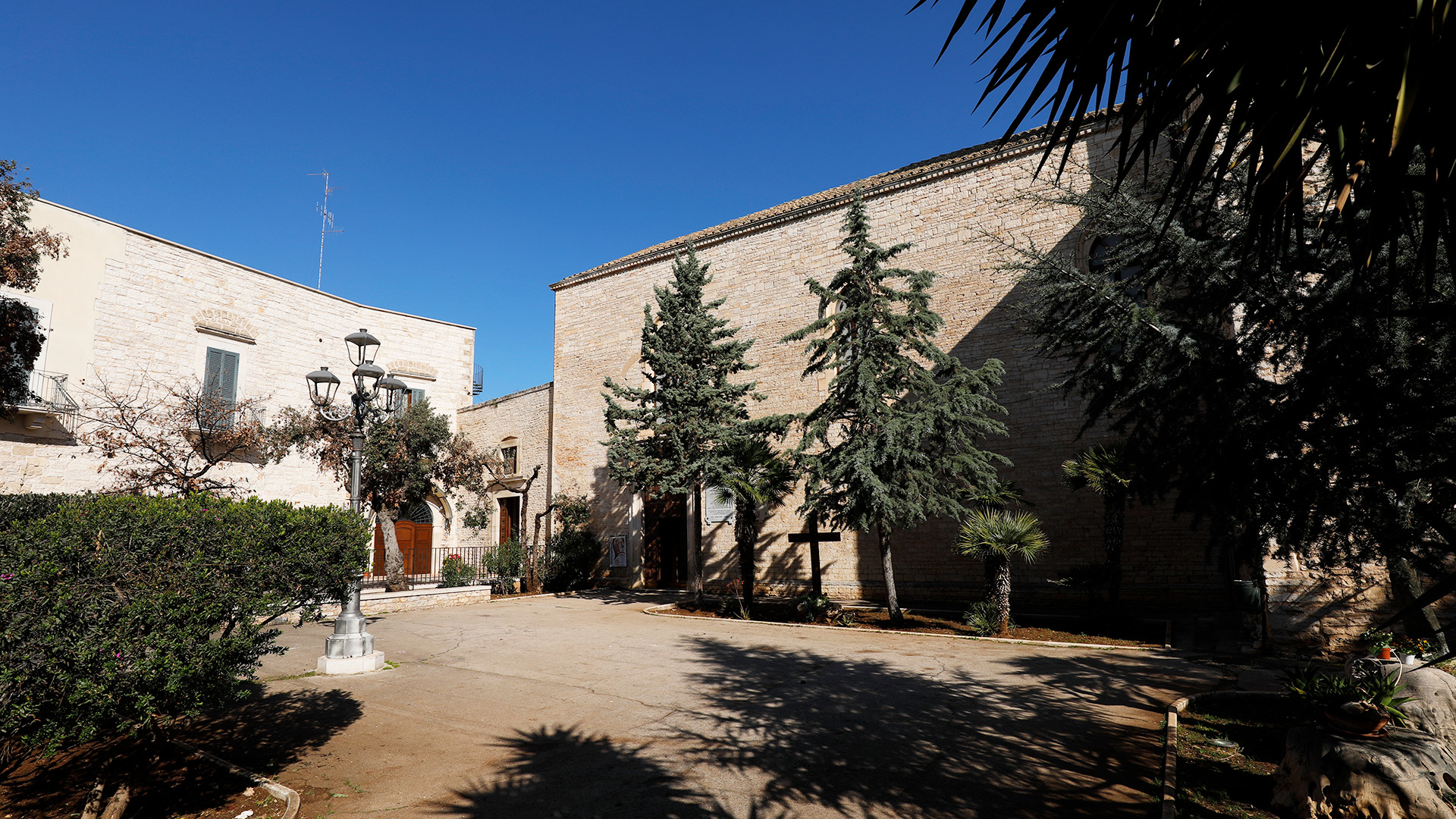
A church dedicated to Saint Leo has been documented in Bitonto as early as 1105, though references to the adjoining monastery appear only later. The Fair of Saint Leo, which brought fame to the site, is attested by 1197 and was later immortalized by Giovanni Boccaccio in the tenth tale of the ninth day of the Decameron..
Initially home to Benedictine monks, the monastery was later taken over by the Olivetan order, who were responsible for the refined cloister built in the 16th century.
In the 19th century, the church and the monastery suffered a long period of abandonment following the repeated suppression of monastic orders. The site was eventually rescued by the Friars Minor, who restored the complex and reconsecrated the church.
Although the origins of the building go back centuries, the church has undergone significant transformations.
The interior was restored in the late 1800s. Lit by six narrow windows, it features a rectangular layout. A pointed arch separates the nave from the transept, where precious medieval frescoes still survive. Painted in the early 14th century, these artworks were rediscovered by Franciscan friars during the restoration work. Restored first in 1918 and again between 1983 and 1985, they belong to the post-Giotto school and unfold across the three large walls of the presbytery.
At the top, the figure of Christ Pantocrator dominates the scene, seated on a golden throne, a symbol of divine kingship. Surrounding Him are the twelve apostles, forming a heavenly tribunal. In the panel below, on the right, an angel leads the damned toward Hell—their faces filled with terror and despair. On the left, the procession of the Blessed moves joyfully toward Heaven. In another section, the Virgin Mary receives a group of abbots and monks and guides them into Paradise.
On the left-hand wall is a depiction of the Crucifixion. Beside the cross stand the Virgin Mary and Saint John the Evangelist; at its foot are Saints Peter and Paul. On the far left, the Saint Leo the Great figure is visible.
Two wings remain of the 16th-century cloister, now partially restored with carved stone fragments from the ancient monastery. These feature arched porticoes resting on columns with beautifully sculpted capitals.



Borgo Racconta is a registered trademark of
BweB – PiccolaGrandeItalia.TV
 English
  Italian
  German