
In the heart of Bitonto’s old town, where the acropolis of the ancient castrum once stood, rises one of the city’s most spectacular churches: the Church of Saint Francis of the Shoe—so named to distinguish it from other Franciscan churches. The building dates back to the 13th century and tells the story of the Franciscan movement’s arrival and expansion in Puglia.
Between 1214 and 1216, Brother Giles of Assisi and other friars arrived in Bitonto, where they met Luca of Bitonto, a learned priest from the cathedral who played a central role in spreading Franciscan ideals throughout the Bari area. After the death of Frederick II and the rise of Charles I of Anjou, the new monastic order found crucial political support. It was during this period that Sergio Bove emerged as a leading figure in Bitonto’s urban renewal. On March 29, 1283, King Charles issued a royal decree granting him the authority to found a grand Franciscan monastery at the city’s highest point.
By 1286, the church was already in use. The original structure followed the typical layout of mendicant orders: a single large nave, a semicircular apse, and a wooden truss roof. Over the centuries, the building underwent numerous changes. In the 15th century, the walls were frescoed and the original windows sealed; in the 16th century, side altars were added; and in the 18th century, Baroque decorations were applied to imitate colorful marble inlays.
The monastery played an important role not only in religious life but also in civil and military history. After the Battle of May 25, 1734, during the War of the Polish Succession, the entire complex was converted into a hospital—a role it would again serve during World War I. Between the two world wars, it became the barracks of the 10th Infantry Regiment under the command of Colonel Michele Lomaglio of Bitonto. On September 9, 1943, Lomaglio famously prevented violence by allowing the German troops to retreat peacefully and calming the local population, who were ready to block their passage.
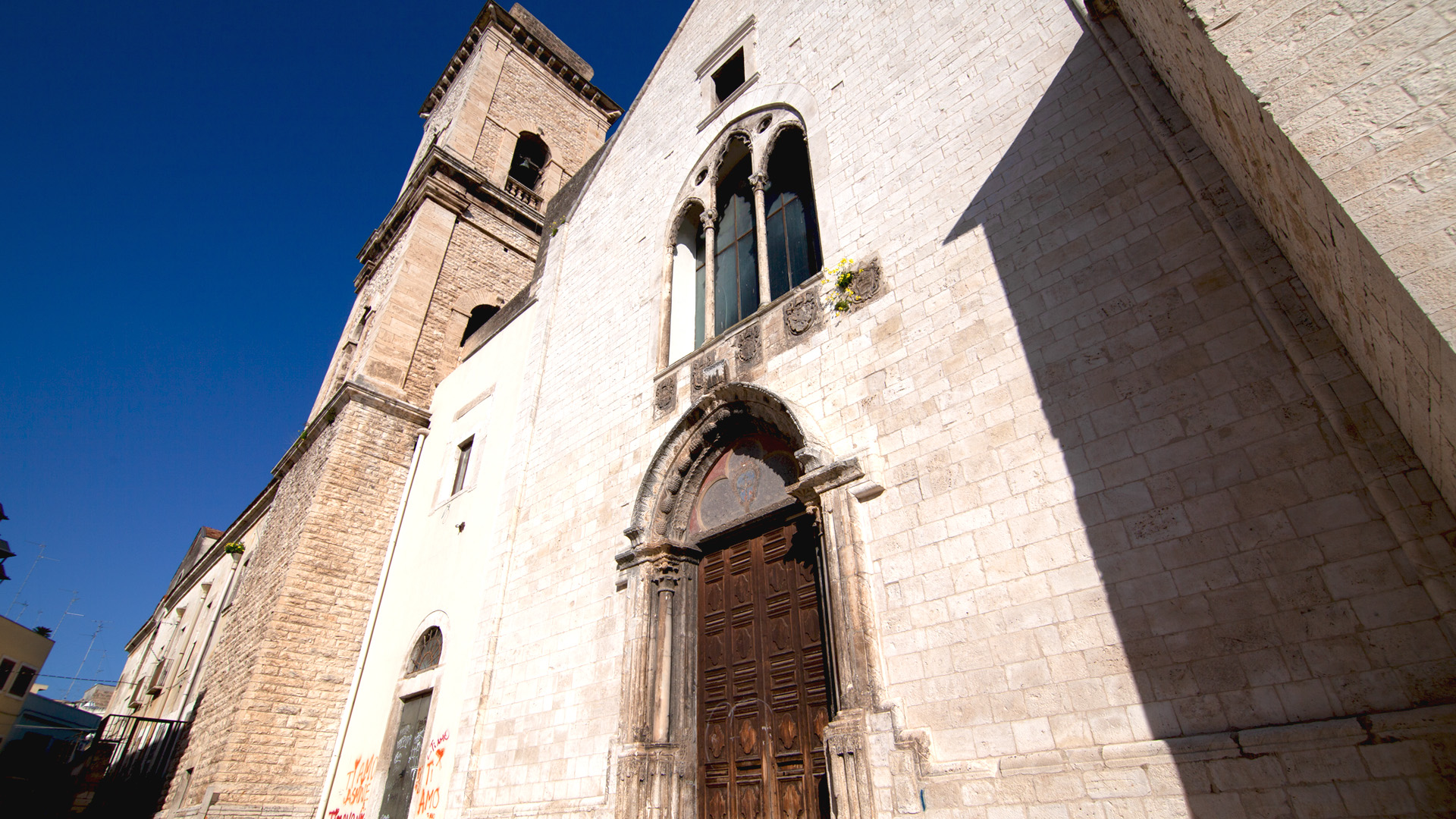
The church’s front is built in the late Romanesque style and is accessed by a wide staircase that enhances its grandeur. The entrance is framed by carved stone arches decorated with vegetal motifs. In several places, you’ll spot the stylized figure of an ox—the emblem of the Bove family. Aligned above the doorway is a beautiful three-light window supported by slender columns and, higher still, a 16th-century window that replaced the original rose window.
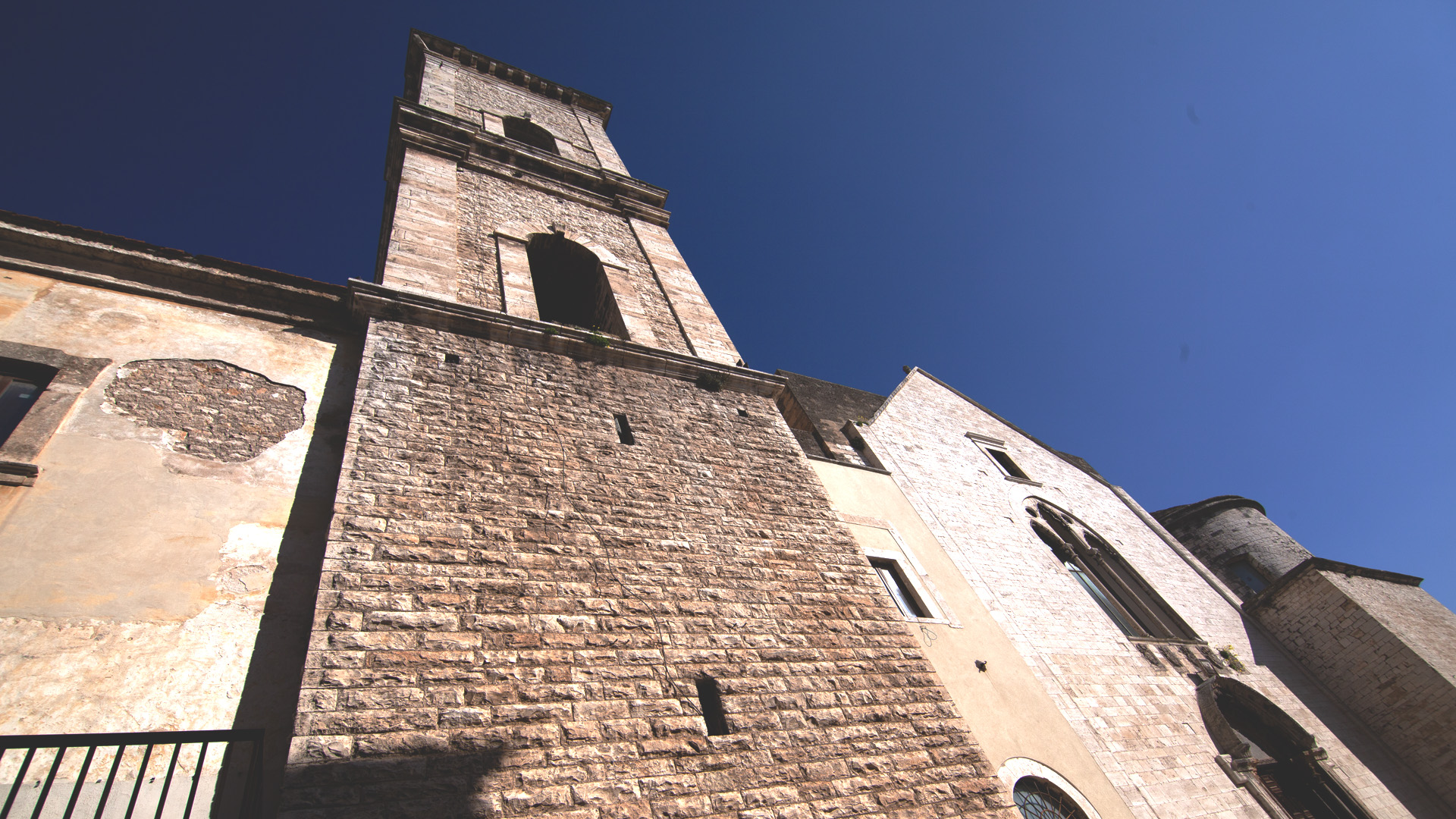
The church’s architectural layout was enriched by adding a sizeable 16th-century chapel topped with a truncated conical dome, an octagonal tower, and a three-level bell tower capped by an onion-shaped dome.
The interior features a single wide nave that impresses with the elegance of its side chapels. The first chapel on the left contains a 16th-century altar with a marble table from Castel del Monte. Above it hangs a painting depicting the Madonna with Saint Andrew and Saint Bonaventure, which frames a precious 14th-century fresco of Saint Francis of Assisi. On the opposite wall, there’s a Byzantine-style Madonna and Child. Also in the nave is a canvas featuring Saint Joseph of Copertino and a 17th-century wooden statue of Mary Magdalene.
The apse, covered by a ribbed vault, houses a Gothic Madonna, the Planelli family’s coat of arms, the burial slab of Bishop Leucius, an inscription with the Bove family’s emblem, and a fresco of Saint Francis receiving the stigmata.
To the right of the apse is the chapel dedicated to Saints Peter and Paul, where recent restorations have uncovered medieval and Byzantine frescoes portraying scenes from the Passion of Christ and figures of the Apostles.


Borgo Racconta is a registered trademark of
BweB – PiccolaGrandeItalia.TV
 English
  Italian
  German